

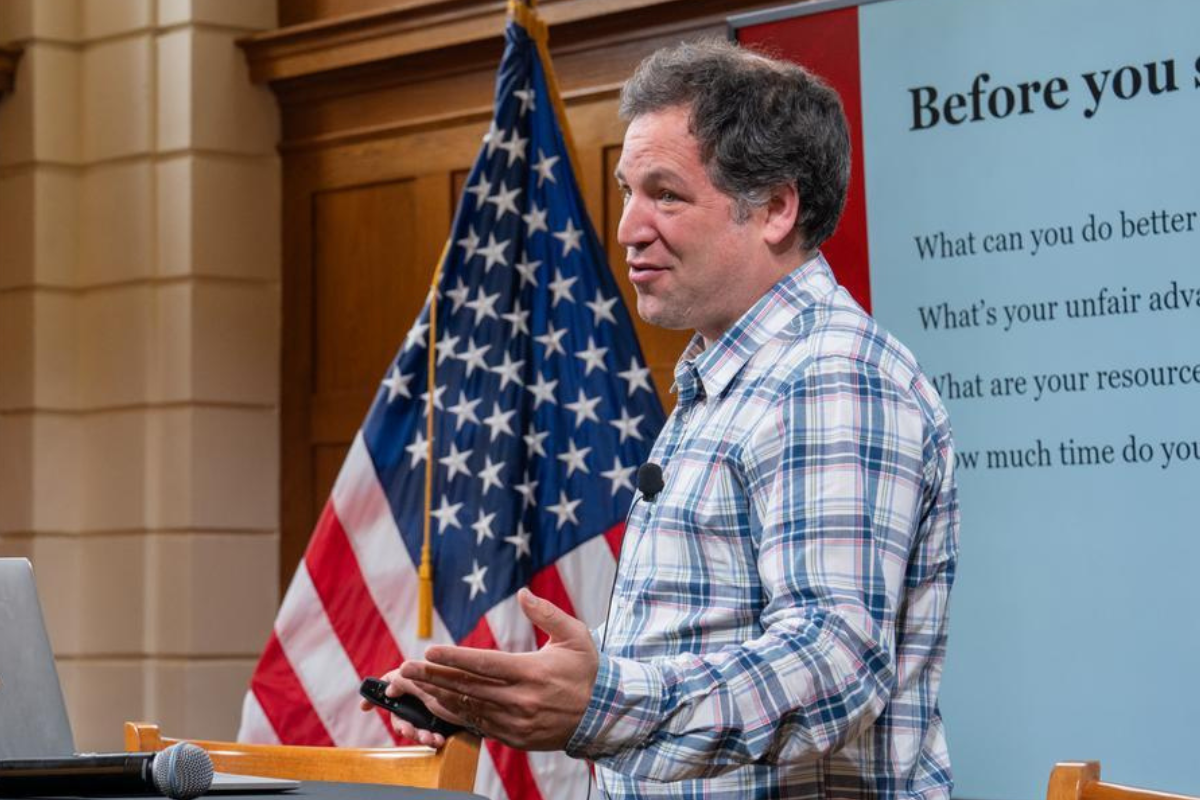
The tools to bring podcasts to market have never been more accessible, but doing a project well and gaining traction is a more complex story. While nearly 80 percent of listeners finish the episodes they start, most podcasts are lucky to reach 100 listeners, said award-winning podcaster Rob Sachs at Monday’s Batten Hour.
Sachs is vice president of audio at Foreign Policy magazine, where he oversees more than 20 podcast shows capturing millions of listeners. He was at Garrett to workshop ideas on how to produce “sticky” podcast content.
“People listen for stories,” Sachs told the students in attendance, urging creators to look for anecdotes to hook listeners in the first crucial two minutes of a segment.
Also joining the Batten Hour was Bobby Doyle, director of UVA’s Gun Violence Solutions Project, which launched a student-led podcast this semester, called “Solving Gun Violence.” The two chatted about what works and what doesn’t in the medium.
Something they agreed on: while podcasts can be easy to produce – there is an open studio available to students in Newcomb Hall, for example – sustaining content beyond an episode or two takes a lot of work on the front and back ends of production. And standing out in a crowded market is easier said than done.
“Ask yourself what can you do better than anybody else can do? What is your unfair advantage? What are your resources and assets?” Sachs said.
The next step is to think about how it will be disseminated, and to whom. Thinking about success metrics outside of number of downloads is important in conceptualizing impact. “The fact of the matter is there are literally millions of podcasts out there and only a very, very small percentage actually make money,” Sachs told students.
Doyle encouraged students to think about how much time they have available to dedicate to a potential project, echoing a sentiment from Sachs.
“If you’re just winging it all the time, people are going to catch on,” he said.
Hence why it’s important to think about all the elements involved: who is hosting or co-hosting? Do they have a brand or following? Will you record asynchronously or an entire season at a time? Will you have different guests, and what production choices such as music, sound, and archival tape (such as news clips) might add dynamic elements to the product? Will there be trailers or video teasing interviews, which creators are increasingly using to package their podcasts and invite listeners.
“The more you can vary the sound and keep people on their toes, the more engaged people will be,” Sachs said.
###


