Editors’ note: This article is part of “Rethinking Our Democracy,” a series on institutional reforms to Congress and the presidency, which is a joint initiative by the Center for Effective Government at the University of Chicago and Protect Democracy. All other articles within this series can be found here.
The current deadlock in the government policy process has many causes. Congress and the president have difficulty working together because of partisan polarization and frequently divided government. That leads the president to try to govern through executive orders, and Congress to push back through oversight investigations, budget brinkmanship and even impeachment. However, one problem gets less attention, even though it has important long-term consequences. Increasingly, both the administration and Congress lack policy expertise, which makes it harder to solve policy problems, break through political disagreement and build coalitions.
In our research, we have focused on how lawmakers in Congress acquire expertise, perhaps improving their effectiveness at lawmaking. We have found that legislators are becoming less specialized, and hence less able to acquire the deep expertise needed to overcome gridlock.
Members of Congress can be foxes or hedgehogs
Our work explores how legislators’ specialization in particular issues affects their ability to advance their agendas. To study this, we looked at each bill proposed in each two-year Congress from 1973-2016, classifying into one of 19 different issue areas from agriculture to education to international trade. We then examined how many issues each member of the House and the Senate tried to tackle in their proposals, as well as how much attention they paid to their top issue. Finally, we compared those who specialized — likely developing policy expertise — with the generalists, to see which strategy was most effective.
We calculated members’ “legislative effectiveness scores” by looking at each lawmaker’s agenda, how far each bill moved through the lawmaking process, and how important the changes it advocated are. In doing so, we also accounted for other factors, such as whether the legislator had a powerful position such as committee chair.
Building on the words of 7th century B.C. Greek mercenary-poet Archilochus, 20th-century philosopher Isaiah Berlin drew a distinction between specialists, who he denoted as “hedgehogs,” and generalists, who he labeled “foxes.” In turn, we refer to a member of Congress as a fox if she dedicates no more than a quarter of her legislative agenda to any specific policy. A hedgehog, in contrast, dedicates at least half of her agenda to the policy in which she seeks (or already has) expertise. The remaining members of Congress are somewhat more balanced in their portfolios.
Obvious foxes in the current Congress, based on their past patterns of specialization, include Reps. Mike Thompson (D-Calif.) and Vicky Hartzler (R-Mo.) and Sens. Kirsten Gillibrand (D-N.Y.) and Mike Lee (R-Utah). On the other side of the spectrum, Reps. Emanuel Cleaver II (D-Mo.) and Mark Amodei (R-Nev.) emerge as hedgehogs in the House, while Sens. Lisa Murkowski (R-Alaska) and Thomas R. Carper (D-Del.) have cultivated some of the most focused policy agendas in the Senate over recent congresses.
We found that in general, hedgehogs are more effective than foxes. The most effective members of the House dedicate about 60 percent of their lawmaking portfolios to a single policy area and limit their portfolio to no more than four issue areas. Effective senators have broader portfolios, which go together with their larger and more diverse constituencies. But even there, the most effective lawmakers dedicate approximately 50 percent of their legislative agendas to a single issue. Specialization has benefits regardless of party, stage of career or position, although we did find that it seems particularly valuable for senior lawmakers and for subcommittee chairs.
Lawmakers are becoming less specialized
Nonetheless, the graphs below show that, while the scope of specialization in both chambers has fluctuated across time, specialization has become relatively rare in both the House and the Senate in recent years. Today, only 20 percent of House members are hedgehogs (dedicating at least half of their bill portfolio to a single issue), with only 5 to 10 percent of senators falling into this category. Furthermore, compared to the mid-1990s (and many other points in congressional history) there are notably fewer hedgehogs and more foxes than there used to be.
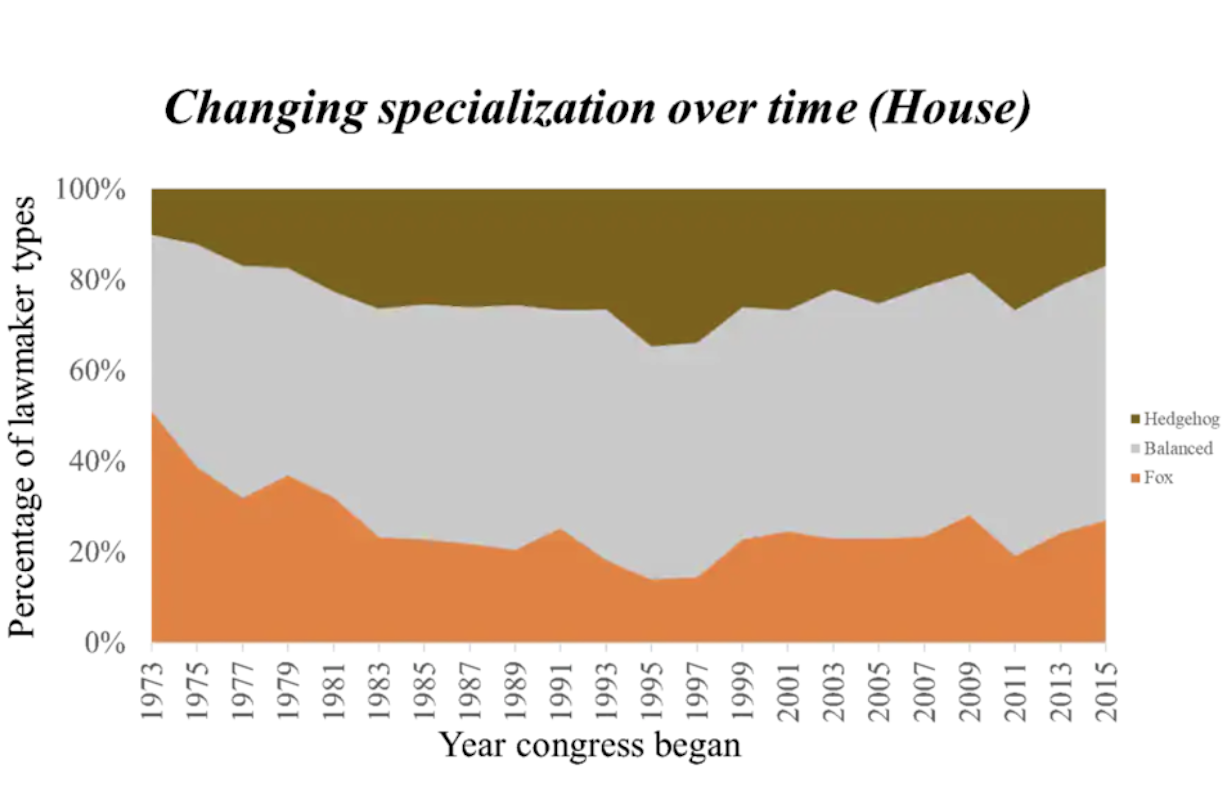
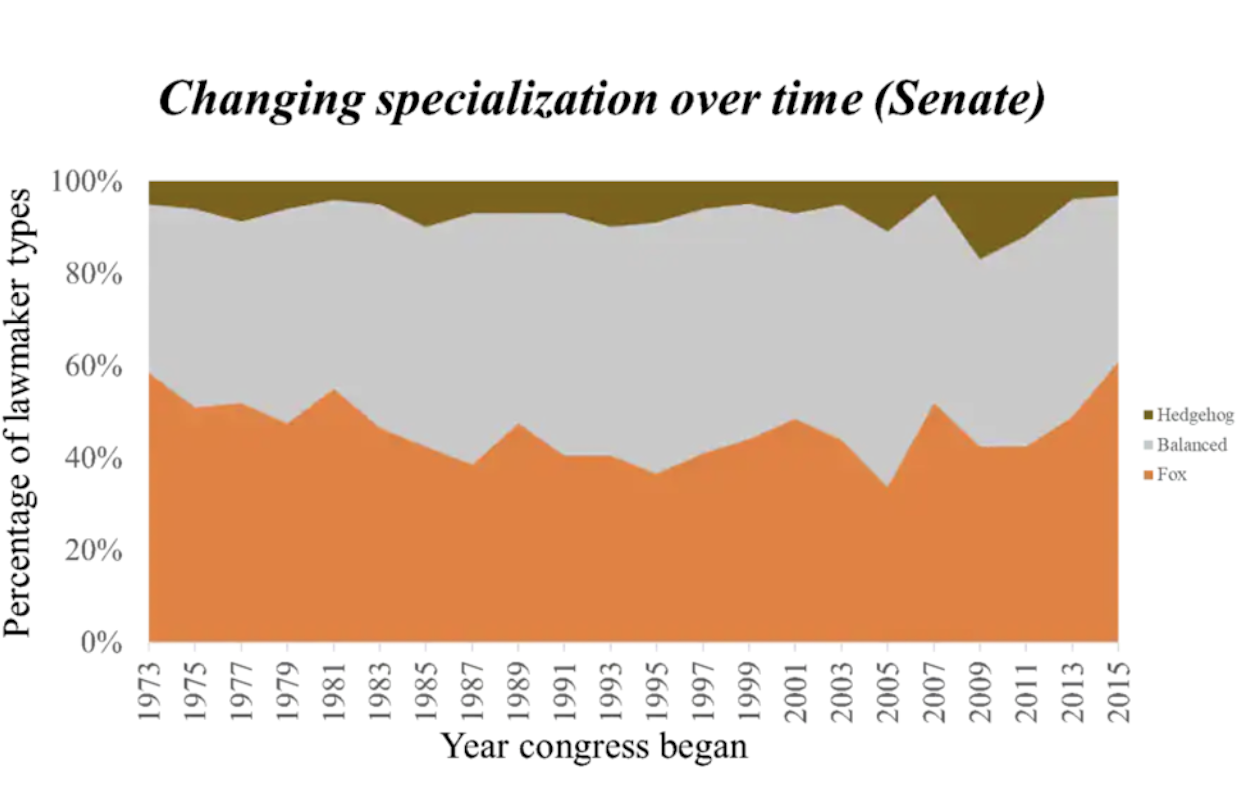
Simply stated, generalists are replacing specialists in Congress. And the rise of generalists appears to accompany less-effective lawmaking.