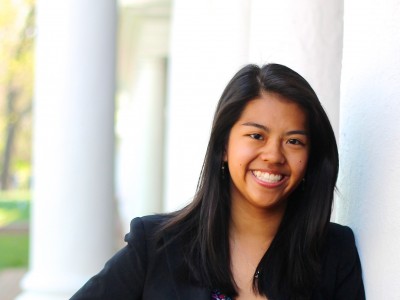
Victoria Tran
Hometown: Wichita, KS
Batten graduation year: 2016
Undergraduate major: Public Policy and Leadership
Extracurricular involvements: Honor Committee, Madison House, Asian Student Union, Sigma Delta Tau
Which policy issues are you most invested in?
My policy interests focus on what needs to be done after a country has gone through a civil conflict. Within the country, my primary focus is economic development and rebuilding. Outside of the country, I am interested in evaluating the migration and political pathways that refugees take to either resettle in the country or find a new home abroad.
How do you hope to advocate for and advance those passions post-Batten?
After Batten, I hope to go to graduate school for development policy and urban planning. That combination of experience will allow me to gain a more cohesive understanding of what policies are feasible for building strong, cohesive cities in countries rebuilding after political or social violence. Urban areas often breed more distrust and resentment between opposing groups during a civil conflict because these populations fight for more limited resources.
Talk about an involvement or experience—internship, job, volunteer position or otherwise—that’s deeply shaped you.
For two summers, I was an intern at the International Rescue Committee (IRC), an international nonprofit that resettles refugees in America and responds to political and environmental crises abroad. My work focused on helping refugees acculturate to their new community, learn English and become economically independent.
I would often have clients that had lived in refugee camps for over 10 years and come to America with next to nothing. Through their resilience and sheer determination, most of them would have jobs within a few months of being in America. I became distinctly aware of how this population adds so much to our community, both economically and culturally, but has few advocates and receives minimal social benefits.
What brought you to Batten?
Batten’s curriculum offers a combination of quantitative and qualitative classes that are unparalleled in any other degree program I sought out. I am able to learn major skills while also applying them to specific initiatives and policies that I am passionate about.
The community breeds leaders and rewards new ways of thinking. Because of the small size of the school, I am able to find others with similar policy interests, and the professors and staff work to actively support my research and work.
How has your experience at Batten changed or shaped your perspective?
Because of Batten, I have become a terrible conversationalist. Every time a new issue or news story is brought up, I have to understand all sides of the story, provide my own potential solutions, carefully evaluate those solutions, and read everything there is about the topic before I can come to a conclusion. This level of critical thinking makes it difficult for me to express my opinion in less than 15 minutes.
What kind of public servant do you think the world needs today?
I think that currently, many of us are content to be a once-a-week volunteer, clicktavist or armchair activist. To address today’s social problems, public servants must do more to solve long-term problems rather than look for simple quick fixes.
In which arena do you hope to be an agent of change?
After I graduate, I hope to work in an economic development capacity, helping those displaced by war and conflict to rebuild their lives, as well as set up political institutions to prevent future conflict and spur economic growth. I hope to continue my advocacy work for overlooked populations and empower those populations to advocate for themselves.