Anyone who has purchased an aspirin, had a baby, gone to the doctor for a check-up, or had any kind of public or private health insurance has participated in the health economy. It’s one of the most extensive and complex systems in modern life, impacting people on a deeply personal level.
And it’s one of the core areas of research expertise at UVA Batten, with three faculty members focused on various aspects of the field.
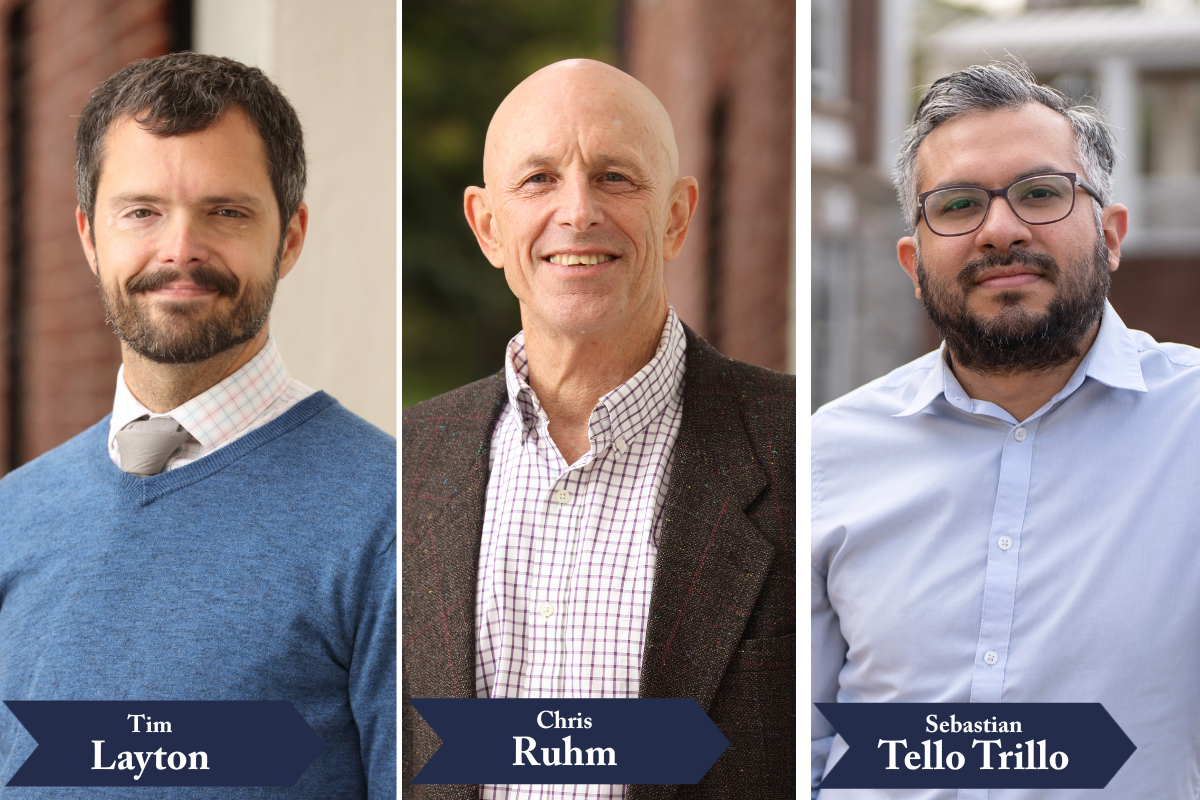
“Health as a sector is enormous and is growing. More than 1 in 6 dollars in economic activity in the U.S. is devoted to health,” said Chris Ruhm, professor of public policy and economics. “It’s a key input into overall well-being. Also, fundamentally, policy is at the center of it.”
Ruhm, who came to Batten in 2010, studies how macroeconomic conditions, individual behaviors, public policies, and other factors shape health outcomes.
He was joined at Batten in 2017 by Sebastian Tello Trillo, associate professor of public policy and economics. Tello Trillo examines how health insurance affects individuals’ behaviors and economic outcomes.
Rounding out the trio is Tim Layton, associate professor of public policy and economics, who joined Batten last fall. His focus is on insurance markets and social health insurance programs.
Within their specialty areas, each of the three scholars is making substantial contributions in evidence-based analyses to help address some of the most challenging, yet critical public policy questions of our time.
“To me, as an economist, it’s fascinating that one of the most important, if not the most important market products is healthcare, and yet there are so many market failures,” Tello Trillo said. “I think it’s imperative that we try to improve it because it’s a matter of life or death.” Over the past decade, he has developed a body of work exploring what happens when people lose health insurance and has studied the question from multiple angles: financial implications, health outcomes, child support, and behavioral health.
“States are now facing budget issues that lead them to want to understand what happens when they make cuts in Medicaid,” he said. He’s found that people who have had insurance might retain some healthcare advantages even if they lose coverage – like knowing what medicines to take or the lifestyle changes needed to resolve a health problem.
Also focused on health insurance, Layton specifically studies the “adverse selection” phenomenon. This occurs when sick people buy insurance at a higher rate than healthy people, driving up costs to the insurers. In turn, the insurers raise prices, leading healthier consumers to drop out, exacerbating the problem. Meanwhile, he said, insurers have a financial incentive to design healthcare plans that appeal to those less in need of costly treatments or medicines.
“You end up with distorted plans and a downward spiral in the market,” Layton said. “There are a lot of different problems with adverse selection, and a variety of public policy tools that are used to try to fix it, but those tools involve tradeoffs of their own.” One of his current areas of study is healthcare for elderly couples, and how the needs of one individual who relies on their spouse for care are impacted when the spouse has a sudden health crisis.
In today’s world of exponential growth in data generation, researchers have access to enormous amounts of information and increasingly sophisticated tools to comprehend it, allowing them to consider even more robust policy questions, Ruhm said.
He’s currently studying an emerging concept called the “deaths of despair” about the relationship between declining mental health and life expectancy in the United States. “Declines in mental health don’t appear to be the major factor in higher mortality rates. It’s played a role, but other things play a more important contributing role,” Ruhm said.
He is also exploring several outcomes of the COVID pandemic. In a paper last year in JAMA Health Forum, Ruhm examined mortality data and levels of COVID restrictions in all 50 states and the District of Columbia. Based on the evidence, he concluded that more stringent restrictions substantially reduced excess deaths. This research could have important implications for public health policy for any future pandemics, he said.
“We’re in a very complicated period. Decisions that we’re making and going to make over the next couple years are going to have an impact for quite a long period of time,” he said. “I think our being able look as dispassionately as we can at the evidence in trying to make our decisions is crucial.”
As state and federal policies and funding involving science and research rapidly shift, the body of work and expertise of Ruhm, Layton, and Tello Trillo will continue to provide evidence-based insights into the important field of health economics. And as faculty members at UVA Batten, they are each inspiring and preparing the next generation of leaders.
“I like the challenge of teaching economics to public policy students, because they sometimes come with a not exactly favorable view of economics,” Layton said. “I love economics. I like showing them how useful and beautiful it is, and how it provides the framework and tools that are really important for policymakers. I really like sharing that.”
###