All recommendations for applicants to our Accelerated MPP and BA programs are submitted using a recommendation form. Read on for tips to ensure your recommenders showcase your strengths and abilities in the strongest possible way!
1. Choose the right recommender.
Our goal in receiving recommendations is to learn more about you as a student and potential leader poised to create impact. As such, you should consider asking for one academic reference at the collegiate level, and the other from an employer, mentor, research supervisor, coach, or other person who knows your work outside of the classroom. Think about your whole application and where there are gaps in what you are trying to present, or where you’d especially like to highlight your strengths, and for that “other” reference, ask someone who can speak about you in that capacity.
Below you can see the form each recommender will be asked to fill out. This is exactly what we’re asking them to weigh in on, so think about people who can speak about your capabilities in these specific areas.
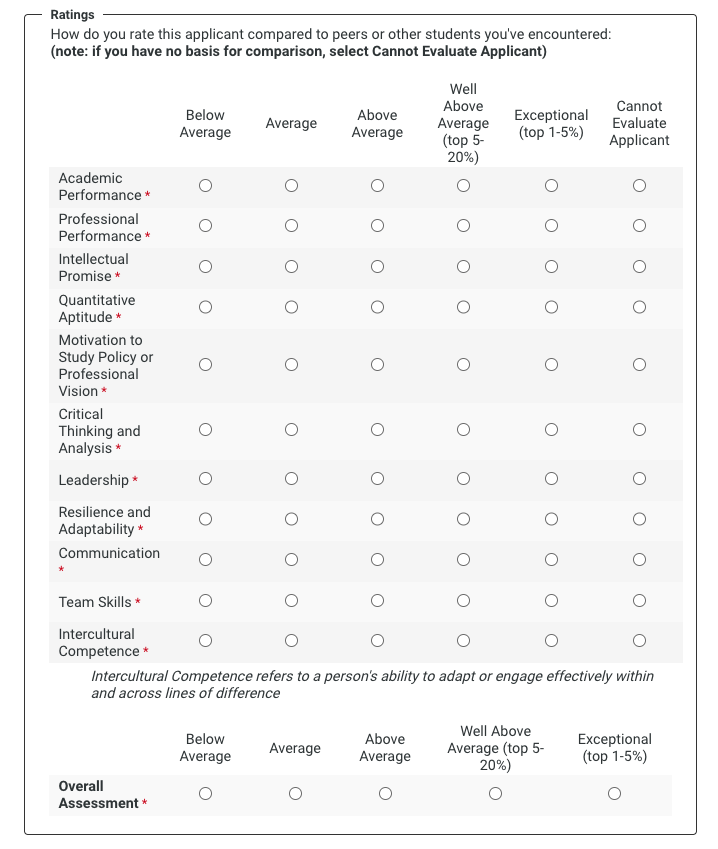
Pro tip: If your recommender prefers, or they’ve already written one, they can also upload a traditional letter of recommendation and provide additional comments about you in the recommendation form.
2. Make sure the person you’re asking to endorse you knows you and your work/skills/passions well enough to give you a strong recommendation.
Having a “senior” person write a generic letter of recommendation without personal knowledge of you and your skills could, in fact, produce a less-than-desired effect. At best, it misses an opportunity to add real value to helping the Admissions Committee get to know you. Titles are not as important as a recommender’s ability to speak in concrete terms about your accomplishments, so don’t discount the perspective of TAs and instructors from smaller courses, like ENWR, COLA, or foreign language classes.
Pro tip: To get a good sense of whether someone will be a good advocate on your behalf, feel free to ask them if they feel they know you well enough to give you a strong recommendation. This will give them an easy out if they are not comfortable, or not equipped, to act as a reference.
3. Connect with your recommender before entering their information into the online application.
By identifying your recommenders early and speaking to them before you begin your application, your request will not come as a surprise, and you’ll have an opportunity to tell them more about Batten, its programs, and why you want to be here; what strengths you feel you bring to the table; what you hope to do with the degree; and other information that will help them speak on your behalf.
Once you’ve made that connection, be sure to enter your recommender’s information into the system, to give them sufficient time to complete the task. They will receive a prompt to provide their recommendation as soon as you save their information in the online application.
Pro tip: When you enter your recommender’s email in the system, consider waiving your right to review their recommendation. The general assumption is that recs are confidential, and your recommender and the Admissions Committee will give the most weight to one that provides the most honest and qualified assessment possible. There’s no need to worry about waiving this access, because you already know your recommender is going to provide a strong recommendation on your behalf (see #2 above)!
4. Let them know why you thought of them to write the recommendation and make it easy!
This helpful context can set the tone and steer their thinking about the kind of recommendation you’d like to receive. It can be helpful to remind them of how long, and under what circumstances, you have known one another. To the extent you can, give your recommender language to talk about your aspirations, why you have them, and how Batten fits into them.
Be polite, be professional, communicate deadlines, and avoid any grammatical or spelling errors if you make a written request to them. Let your recommender know they will receive an automated message from our system which will provide the link for them to submit their recommendation. Give complete information and make sure to put your best foot forward!
Pro tip: When you input your recommender’s name and email into the application, you can also include a personalized note that will be included when they are sent their link.
5. Remind your recommender of your positive interactions.
The goal is to receive a recommendation that tells an accurate story about your relationship, your strengths, the experiences you’ve had together, and your fit for the program. Take the initiative by reminding the recommender of the interactions that make them qualified to recommend you. Is there a specific time, trait, or project you want them to focus on? If there are talking points you want them to hit, go ahead and state them!
6. Provide evidence.
In addition to telling them exactly what you are applying for and why, be sure to provide concrete examples—whether a class performance, project or assignment, or role that you performed in relation to them—that will really help distinguish you. Speak honestly about your accomplishments and talk about why you think our programs are a good fit. Make sure the examples you provide align with the mission and values of the program you are applying for. (Pro tip: check Batten’s website and look for cues there!)
You can also give your recommender a copy of your resume, your transcript, and even your personal statement/short essays to help paint a more complete picture of you. Consider this important background information but know that it will be helpful if they focus more on your strengths and skills as they’ve experienced them, and less on your accomplishments outside of your interactions, as those are something the Admissions Committee will be able to see in other parts of your application.
7. Send your recommender a polite reminder one week before application deadlines if they haven’t yet submitted their recs.
Even though you can check on the status of your recommendation letters in the application portal, feel free to reach out directly to your recommender to remind them about due dates. All recommendations are due by the application deadlines for each program, though we give recommenders a grace period of one additional week to submit the rec form. If your recommender has trouble accessing the form and did not receive the request after checking both their inboxes and spam folders, please email us at BattenAdmissions@virginia.edu to help troubleshoot.
Follow these tips and we guarantee you have laid the groundwork for a successful recommendation!