Imagine that you’re a policymaker and you have to make a decision quickly on a major issue. What if you’re the head of a low-income household and you’re faced with difficult choices in how to spend your limited budget?
Professor Jeanine Braithwaite recently hosted a poverty simulation in two of her classes, Development Policy Nudges and International Development Policy. The simulation was developed by the Missouri Association for Community Action and was used as part the new initiative to integrate simulations into the Batten curriculum. In simulations, students often work in small teams and test the theories they discuss in class, working to find the most plausible and effective solution.
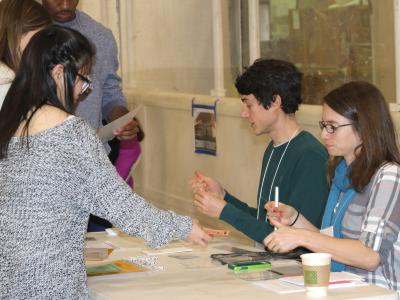
With nearly 75 students present and 100 percent participation, the simulation took place in a university gymnasium to accommodate the many stations and groups. Each student held a specific position that provided him or her with various roles and dealt with the real life constraints of impoverished people, such as money, time and bandwidth.
Professor Braithwaite said, “My objectives were to give students a feeling for what it is like to be poor. I’m teaching two classes this semester about how to get countries out of poverty, so I particularly wanted students to have an experience like this simulation. A second goal was for students to develop empathy as a result of improved understanding of the constraints poor people face.”
Students left the simulation with more knowledge and a greater understanding than had they just read about the topic. Simulations are successful in this purpose because they allow for a different perspective, providing participants with a diverse set of interactive roles and challenging them to find solutions to real life problems.
In addition to role playing, the experience gave students skills such as problem solving and quick-on-their-feet thinking that will help them design and implement successful policy. This experience in decision-making contributes greatly to the students’ understanding of leadership in the public policy arena.
As for the future of simulations at Batten, Professor Braithwaite said, “I think live action role-playing simulations are a wonderful pedagogic device. A longer-term goal would be to adapt the simulation to profile a developing country.”