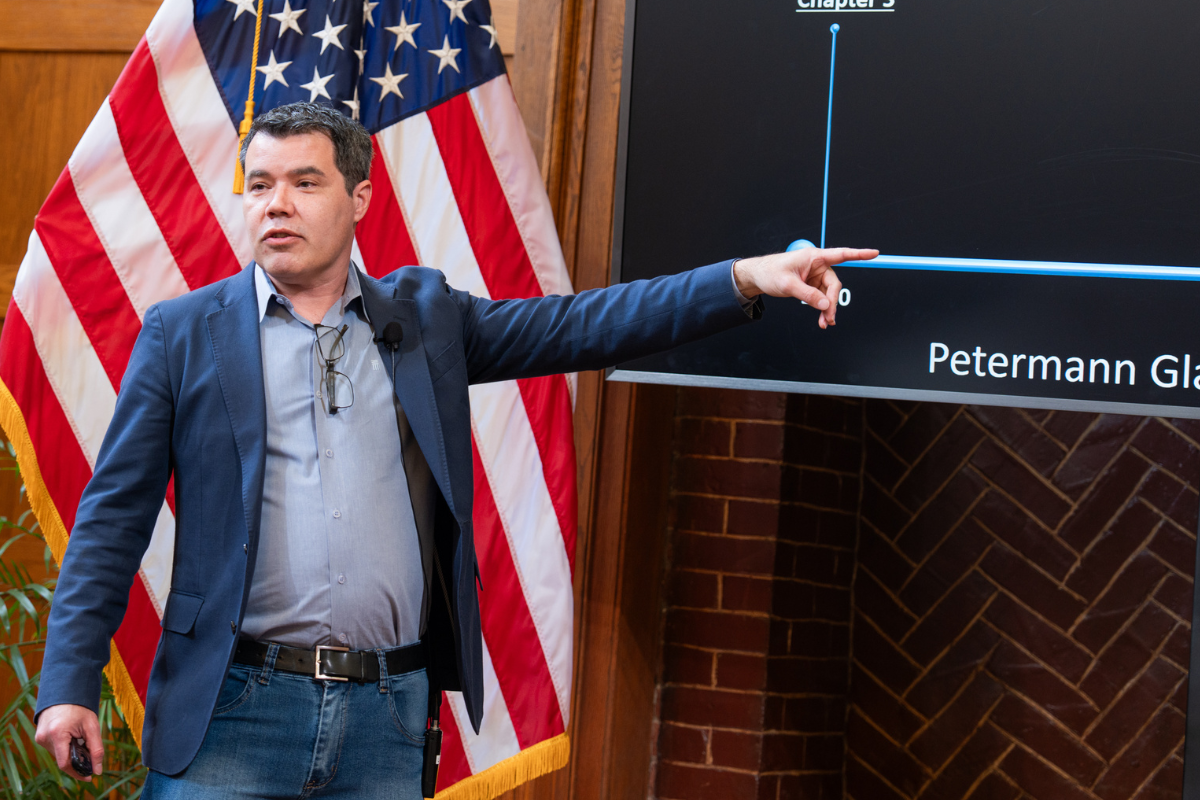
Garrett Hall hosted veteran climate reporter Chris Mooney for Monday’s Batten Hour to discuss the intersection of data and narrative to tell stories that capture and change the direction of policy. Mooney is currently a professor of practice and a practitioner fellow at the UVA Environmental Institute which co-sponsored the event.
Mooney has been a journalist for more than 20 years and spent more than a decade working for the Washington Post. In 2019, he and his team won a Pulitzer Prize for the series, “2 Degrees Celsius: Beyond the Limit,” which used global temperature datasets to identify the parts of the world heating up fastest.
“Data is a powerful roadmap to story,” Mooney told the audience, emphasizing there are more datasets than reporters to cover them. “Journalists have a lot of work left to do.”
How reporters can and should practice the craft of storytelling through data was the throughline of Mooney’s presentation. He said newspaper jobs have declined 80% over the last three decades. In contrast, there are an average of 14,000 studies on climate change being produced globally each year, and the concentration of data reporting on the topic has largely been at legacy publications like the New York Times and Washington Post.
“This is complex work, it’s specialized work,” Mooney said, adding that despite declining numbers of journalists and newspapers, “they’ve paid more attention to climate change over time and that is just because of the salience of the topic.”
He pointed to his own experience using heat maps as an anecdote for finding hidden stories in plain sight. “The Arctic story had been told, but there were a lot of others that had not,” he said. “I had written about the Gulf Stream repeatedly, but I had not known to look at the South Atlantic – there was no journalism about the South Atlantic.” A data visualization map of the globe showed ocean warming near Uruguay and Argentina on the same order of Arctic Ocean warming. Mooney’s further reporting revealed the impact to the local fishing communities.
These stories and many others live at the nexus of research and storytelling, and can change the trajectory of policy, Mooney said. “Policymakers should base policies on data for sure, to the best extent that they can, but if they want to communicate [those polices] effectively to audiences, I think that they would find that stories are more easily apprehended than strictly analytical presentations.”
Mooney said that in his role at the Environmental Institute, he is striving to create a bridge between storytellers and data analysts. He believes this hinges on training younger journalists while fostering stronger partnerships with academia so both can have a better view of what they might be missing.
“Sometimes a data point is not only a data point, sometimes it is also a story.”
###