

Published Research
Lorem ipsum dolor sit amet, consectetur adipiscing elit, sed do eiusmod tempor incididunt ut labore et dolore magna aliqua. Ut enim ad minim veniam, quis nostrud exercitation ullamco laboris nisi ut aliquip ex ea commodo consequat.
-
 ResearchAnger Damns the InnocentFalse accusations permeate social life—from the mundane blaming of other people to more serious accusations of infidelity and workplace wrongdoing. Importantly, false accusations can have grave consequences, including broken relationships, job loss, and reputational damage. In this article, we document an equally pernicious phenomenon—the misuse of anger as a cue to predict whether a suspect has been falsely accused.
 -
Strengthening public policies for decent work in Francophone Africa in the context of the COVID-19 pandemicThe project seeks to analyze the impact of the COVID-19 pandemic on small informal businesses in Benin, Cameroon, Morocco, and Senegal. It will explore policy options for targeted support to those businesses in a way that helps contain the spread of COVID-19 and similar pandemics in the future. It will also seek to identify the best options for building the long-term resilience of vulnerable population groups involved in small informal businesses.
-
 ResearchWage Insurance and Labor Market TrajectoriesWage insurance provides income support to displaced workers who find reemployment at a lower wage. This group of scholars study the effects of the wage insurance provisions of the US Trade Adjustment Assistance (TAA) program using administrative data from the state of Virginia. What they find suggests that wage insurance eligibility increases short-run employment probabilities and that wage insurance and TAA training may yield similar long-run effects on employment and earnings.
 -
 ResearchHonor Among Thieves: Understanding Rhetorical and Material Cooperation Among Violent Nonstate ActorsWe find that when groups share an ideology, and especially a religion, they are more likely to sustain material cooperation in the face of state repression.
 -
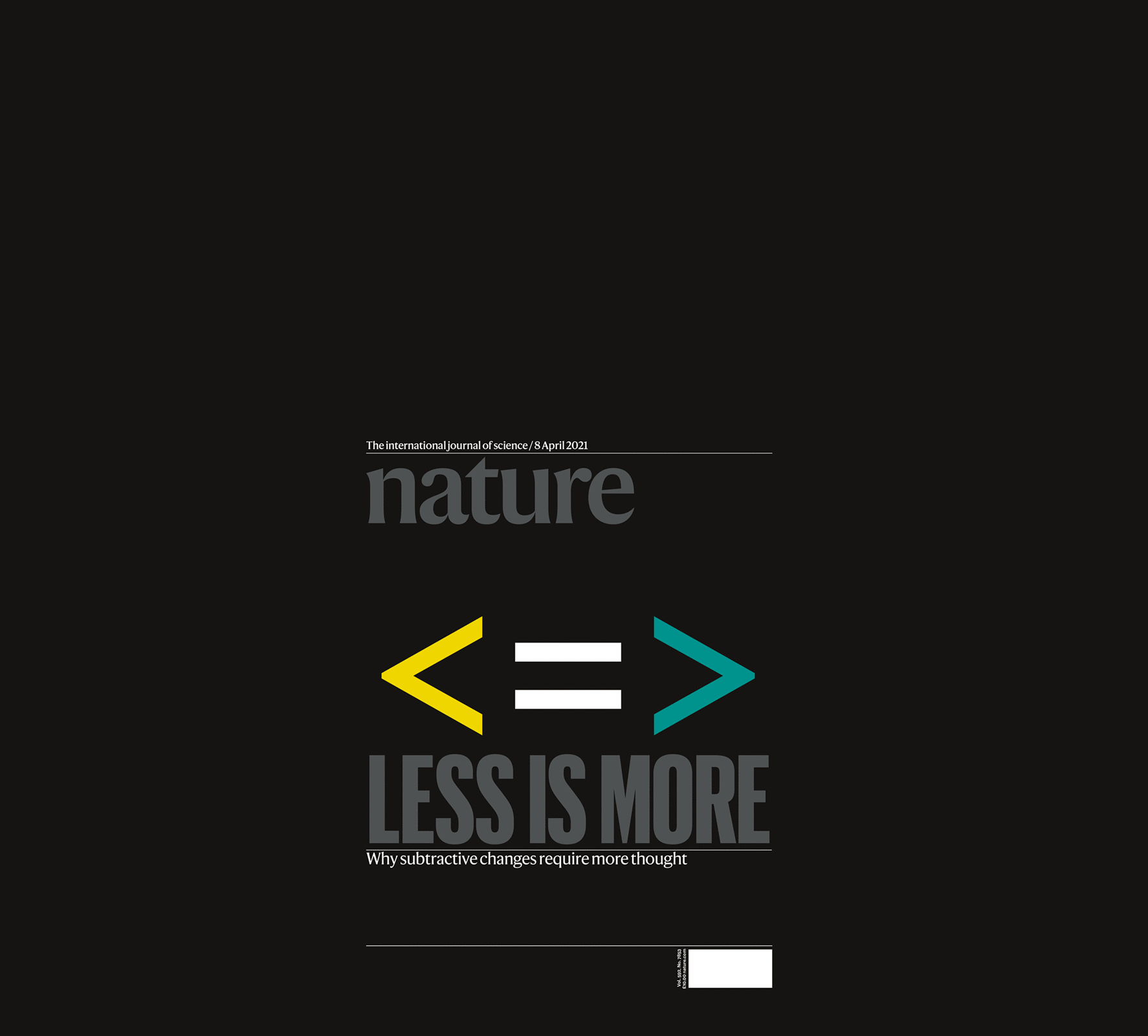 People systematically overlook subtractive changesA series of problem-solving experiments reveal that people are more likely to consider solutions that add features than solutions that remove them, even when removing features is more efficient.
 -
ResearchNew Case – Culinary Concepts AB and the Employment Crisis in Food and Beverage in CharlottesvilleAntwon Brinson believes in the power of culinary arts to bring about systemic social change. This case study addresses how Antwon’s social venture, Culinary Concepts AB (CCAB), approached the employment crisis felt throughout the food and beverage industry, by teaching life skills through culinary arts.
-
ResearchNew Case – ReadWrite Digital: Improving Student Outcomes Through Educational InnovationReadWrite Digital is an education technology startup that offers software to K–12 schools in the United States to provide education analytics and personalized education planning. Founded in 2012 by Rob Simms, the current President and CTO, ReadWrite Digital built, developed, and launched two unique products, Integrator and Analytics, providing an end-to-end solution for data collection from disparate systems creating rich analytics for student performance in one place.
-
ResearchNew Case – RVA Works: Empowering Entrepreneurs for Big ChangeRVA Works (a shortening of Richmond, Virginia Works) is a public charity, which has demonstrated superior efficacy in educational programming for entrepreneurship. Since 2014, their work has primarily focused on providing pathways to business ownership for ethnic minorities, women, and lower-income people.
-
ResearchExploring Social Business Pathways: Green Map System as a Case in PointSocial entrepreneurship holds promise as a way for organizations to create value for both individuals and communities. The objective of this paper is to observe and analyze the ways Green Map System, a not-for-profit social venture, supports sustainable community development and local leadership by sharing tools, icons, and technology for mapping eco-sites around the world. The role of technology and digital networks, as well as the impact of global linkages, is also observed and emphasized.
-
Working PaperStacking the Deck for Employment Success: Labor Market Returns to Stackable CredentialsWith rapid technological transformations to the labor market along with COVID-19 related economic disruptions, many working adults return to college to obtain additional training or credentials. Using a comparative individual fixed effects strategy and an administrative panel dataset of enrollment and employment in Virginia, we provide the first causal estimates of credential “stacking” among working adults.
-
Working PaperPushing College Advising Forward: Experimental Evidence on Intensive Advising and College SuccessGrowing experimental evidence demonstrates that low-touch informational, nudge, and virtual advising interventions are ineffective at improving postsecondary educational outcomes for economically-disadvantaged students at scale. Intensive in-person college advising programs are a considerably higher-touch and more resource intensive strategy; some programs provide students with dozen of hours of individualized assistance starting in high school and continuing through college, and can cost thousands of dollars per student served.
-
Working PaperNudges Don’t Work When the Benefits Are Ambiguous: Evidence from a High-Stakes Education ProgramThe Post-9/11 GI Bill allows service members to transfer generous education benefits to a dependent. We run a large scale experiment that encourages service members to consider the transfer option among a population that includes individuals for whom the transfer benefits are clear and individuals for whom the net-benefits are significantly more ambiguous. We find no impact of a one-time email about benefits transfer among service members for whom we predict considerable ambiguity in the action, but sizeable impacts among service members for whom education benefits transfer is far less ambiguous.